Do I need LinkedIn API approval to start?
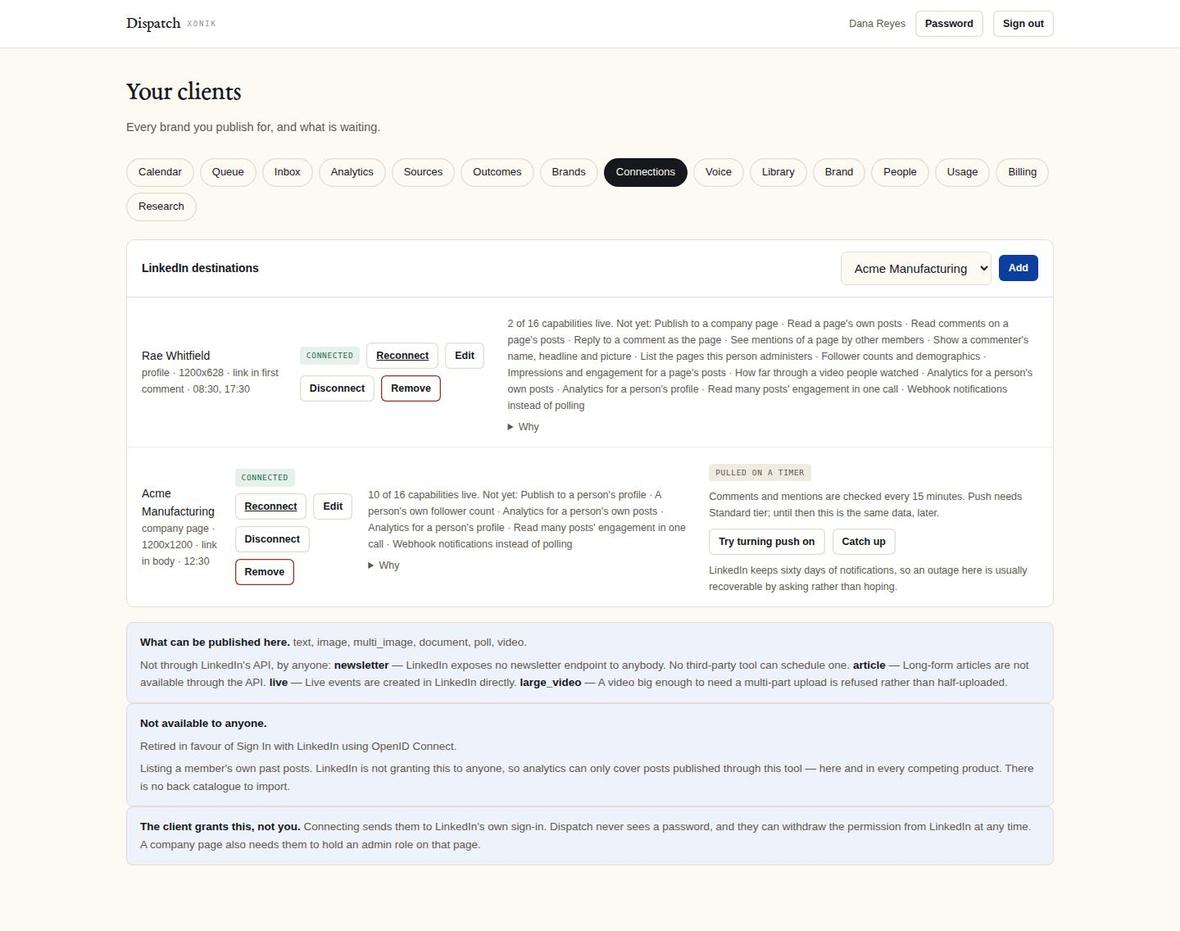
No. Dispatch publishes to LinkedIn profiles through XONIK's approved LinkedIn application, so you connect your profile and start. Company pages are coming to the Enterprise plan.
What happens when a source I cited changes after the post is live?
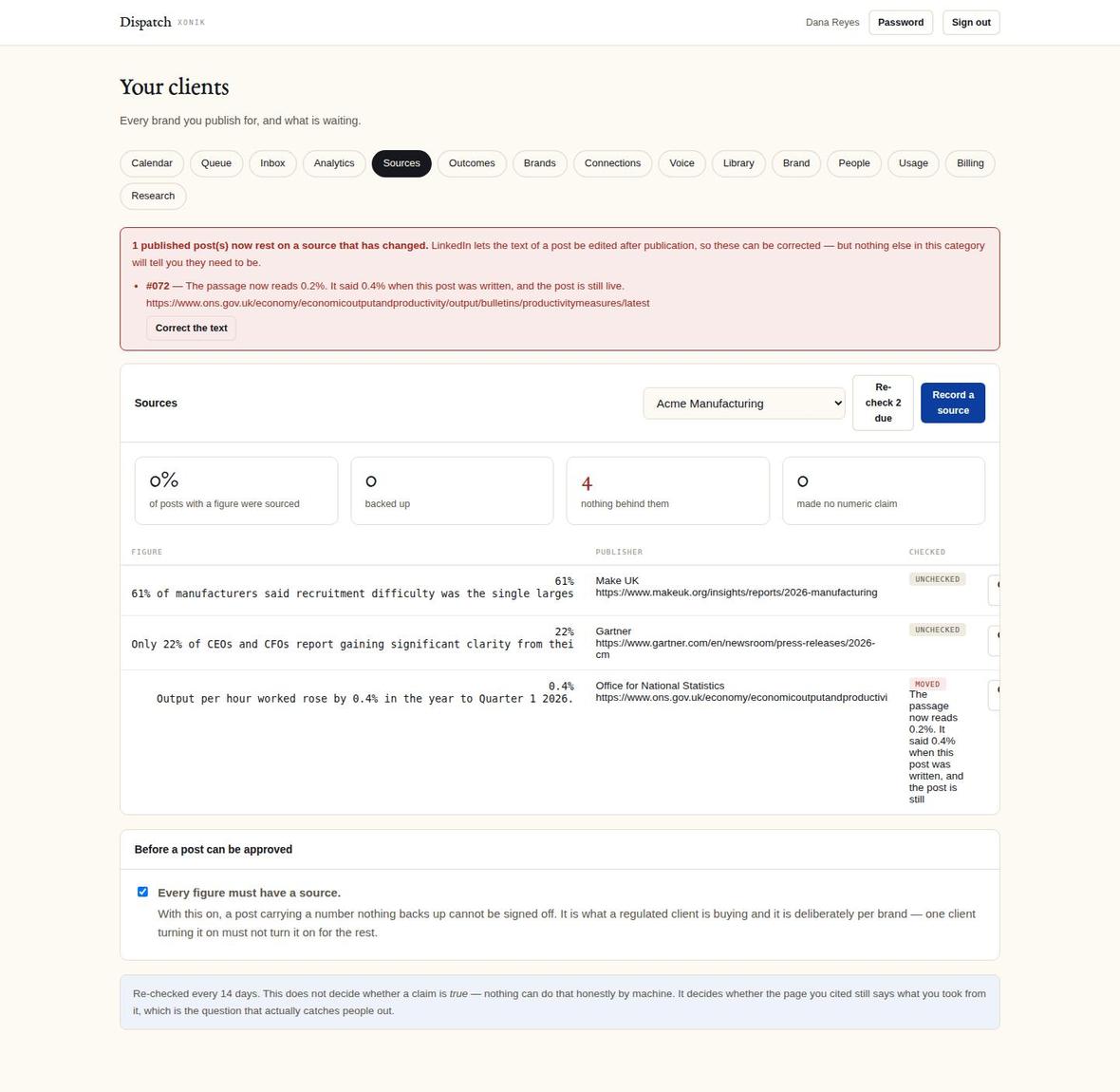
Dispatch re-fetches the page on a schedule and compares it with the sentence recorded at the time. When it differs, the live post resting on it is named, with the old figure, the new one and the date of the check. It flags; it never edits or deletes a published post.
Does my client need an account to approve a post?
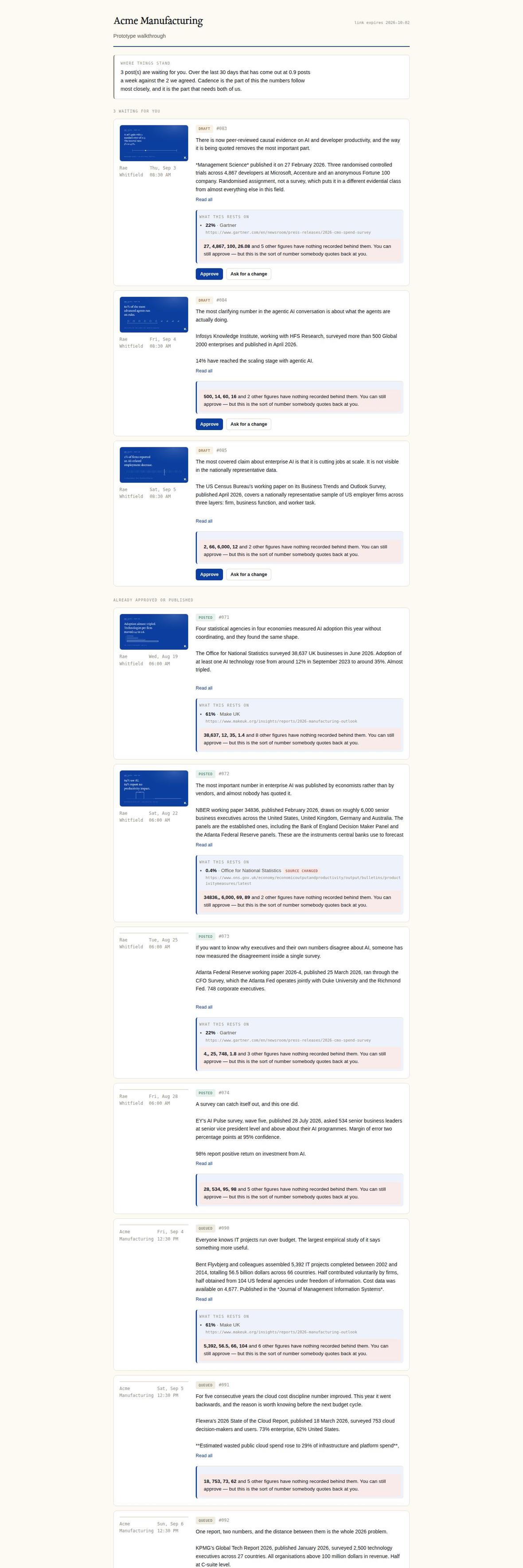
No. They open a signed, expiring link scoped to one brand, see the post as it will appear with its sources underneath, and approve it or send it back with a reason.
Can one agency see another agency's brands?
No. Every row carries the brand it belongs to and every query is filtered by it. Cross-account reads are the failure most likely to end a company, so isolation is proved by a dedicated suite of automated checks rather than by convention.
Is anything published automatically?
Never without an approval carrying a name. Approval is bound to a fingerprint of the exact text, so editing an approved post drops the approval — including when the edit puts the words back.
Do you scrape LinkedIn or automate connections and messages?
No, and the line is drawn at sending rather than at writing. No scraping, no automated connection request, no automated message, no scraped database of people. Dispatch will draft a reply to a comment on your own post, and a message to one person you have told it about, because both are writing. It sends neither, and it keeps no record of who you wrote to: a lead database plus automated outbound is what gets a platform application revoked, and that stops every customer publishing rather than only the one who wanted the feature.
What does it cost, and how are the limits counted?
Hosted plans run from a free trial to an agency plan, billed by the year, with limits counted per account rather than per brand, enforced by the software, and a post's slot handed back when it is pulled or fails for good. The licensed edition is a licence fee instead: higher in the first year because it includes the installation, lower each year after for the licence, the updates and the support window. One licence covers one person and one company; a second company is a second licence rather than a bigger one. Both editions run on your own model key, so neither has a token allowance we sell you.
Can I cancel, and do I get money back?
On a hosted plan, cancel from the panel at any time. Inside 14 days of a first payment we refund it in full, no reason needed. After that we refund the months you have not begun, less what the payment provider kept — three months into a year, nine come back. A licence is a term rather than a subscription: what it costs to end one early is in the licence agreement, which you read before you sign it rather than after.
Does it check my profile too?
Yes, and it is the part of this nobody else does. Your headline is read beside every comment you make and in every search result you appear in, and nothing has ever checked it — a post carrying a figure is flagged here before anybody approves it, and a headline carrying the same figure has been checked by nothing, by anybody, ever. So paste your headline and your About section in and they go through the same checks a post does: every figure against its source, every claim against what is confirmed about the business, every line against what you have already published. Then it is watched — a year on, it says so, because it is the one piece of published text nothing re-reads. Two things it will not do: it cannot read your profile, because the network does not hand that text to an application and we will not pretend to have looked; and it gives you no score, because there is nothing measured behind one.
Who writes the posts?
You do. Research briefs and drafts are assembled with the help of a language model, and everything generated is labelled as such and waits for a person to approve it.
Can we run it ourselves, or buy the source?
Run it, yes — that is the licensed edition, and it is what most people mean. It is installed on your own server, under your own name, on your own LinkedIn application, and the database never leaves your machine. The source, no: the software is licensed and not sold, ownership does not move, and source escrow is what we arrange when the worry is what happens should XONIK stop. Your model key is your own in both editions, so your model spend never depended on our goodwill either.
What is the difference between hosted and licensed?
Whose LinkedIn application the post leaves under, and that decides what can be posted to. Hosted runs on ours and publishes to people’s profiles. A company page needs the network’s Community Management access, which it grants to one application for its own pages, so a page is reachable only from an installation holding that access for itself — the licensed edition, on your application. That access is something you apply to the network for and it reviews over weeks; it can refuse. A profile needs no review at all. Everything else is the same software.
What happens when a licence is not renewed?
It warns for thirty days first, on every screen, and names the date. If the date passes, publishing stops and nothing else does: you can still sign in, read every post, every source and every approval, and export them. The data is kept for the period in the licence agreement and is then destroyed. Renewing at any point in that window starts publishing again with nothing lost.
Whose bill is the model spend?
Yours, and it goes to you from your own vendor. You put your own key in; the calls leave under it. We do not resell model access and we do not mark it up. If you stop paying us, the key keeps working — it was never ours to switch off. Your access to the network, your model spend and, in the licensed edition, your data do not depend on our goodwill.
Can I see it working before connecting an account?
Yes. Signing up puts you in a sandbox with seeded posts and their sources, where publishing goes to a mock and nothing reaches the network. Every surface says so. A live account is set up afterwards, in a conversation.
Does Dispatch ever act on LinkedIn by itself?
Never. It does not like, comment, message or connect on anybody's behalf, it does not scrape feeds or profiles, and it does not run inside LinkedIn through a browser extension. It publishes only posts a person has approved, through LinkedIn's official API.
Do I need a card for the trial?
No. The trial runs for 14 days with one brand and ten posts, and nothing is charged until you choose a plan.